
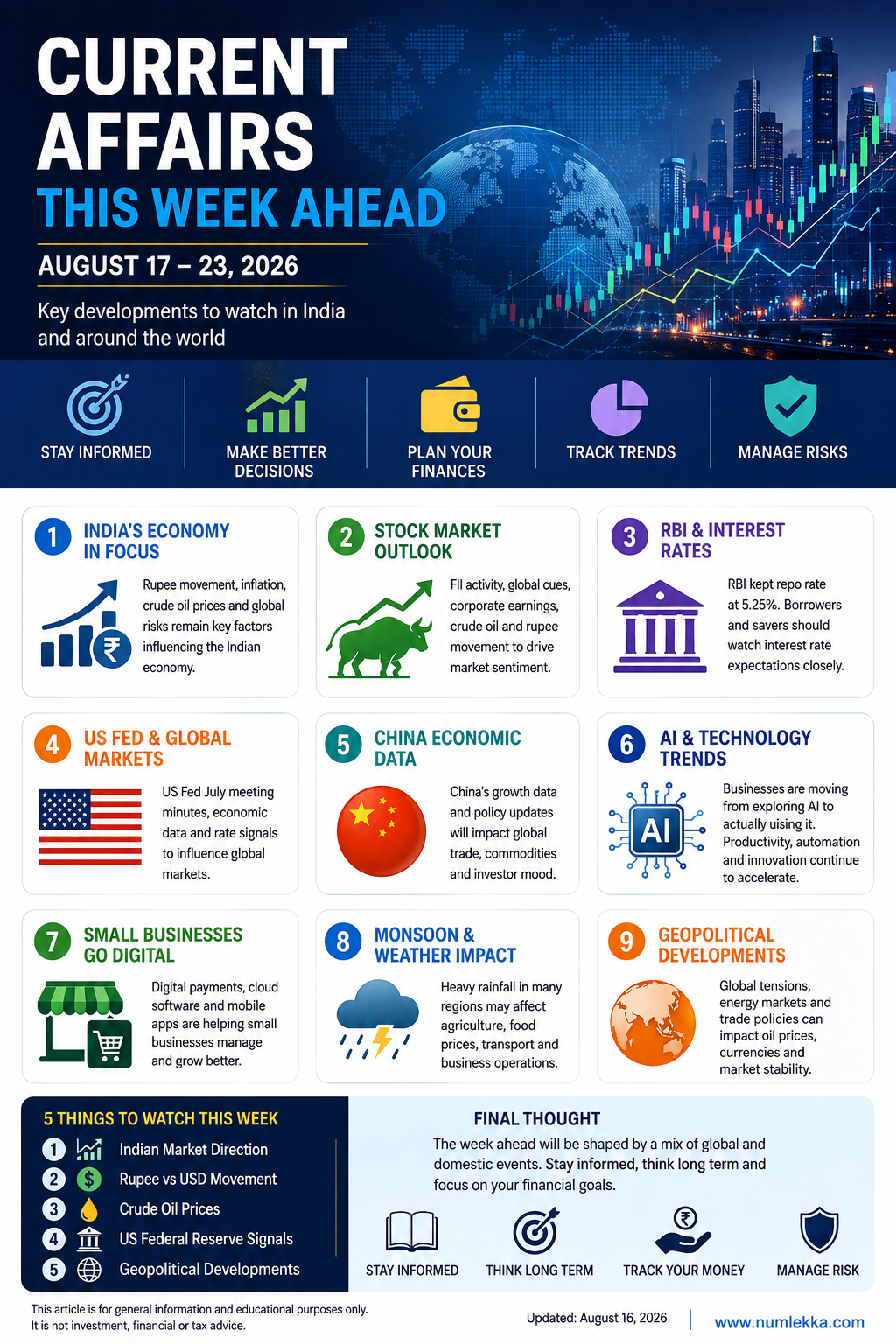
Current Affairs This Week: What to Watch from August 17–23, 2026
*India, Economy, Markets, Business, Technology & Global Affairs*
A new week begins with several developments worth watching across India and the world. For individuals, investors, entrepreneurs and small-business owners, the biggest stories are not just political headlines—they can influence markets, inflation, interest rates, fuel prices, business confidence and everyday finances.
Here are the key developments to watch from August 17 to August 23, 2026.
🇮🇳 1. India’s Economy Remains in Focus
India enters the week with attention firmly on economic conditions, the rupee, inflation and global risks.
The Indian rupee ended the previous week slightly weaker against the US dollar. Rising crude oil prices and geopolitical uncertainty remain important factors because India imports the vast majority of its crude oil requirements.
Why it matters
A weaker rupee and higher crude prices can eventually affect:
For ordinary consumers, the connection is simple: global events can eventually reach your monthly budget.
📉 2. Stock Market: A Volatile Week Ahead?
Indian equities ended the previous week on a weaker note, with the Sensex losing around 500 points and the Nifty declining about 205 points.
For the week ahead, investors will be watching global markets, corporate earnings, macroeconomic developments and foreign institutional investor flows.
This does not necessarily mean that markets will continue falling.
Instead, investors should expect sentiment to remain sensitive to new information.
What investors should watch
*• FII activity*
Foreign investor buying and selling can influence short-term market direction.
*• Global markets*
Movements in US, European and Asian markets can influence Indian equities.
*• Corporate earnings*
Results and management commentary can move individual stocks and sectors.
*• Crude oil*
Higher oil prices can create pressure for oil-importing economies such as India.
*• Rupee movement*
Currency fluctuations can influence companies with significant import or foreign-currency exposure.
Important: Short-term market movements should not automatically change a long-term investment strategy.
🏦 3. RBI and Interest Rates Remain Important
The Reserve Bank of India kept the repo rate at 5.25% at its August 2026 policy meeting and retained a neutral stance.
That makes the interest-rate environment particularly important for borrowers and savers.
For borrowers
Interest-rate expectations can affect the cost of:
For savers
Interest rates also influence:
For households, the lesson is straightforward:
*Don't look only at the EMI. Look at the total interest you will pay.*
🌍 4. Global Markets Will Watch the US Federal Reserve
One of the important global events this week is the release of the US Federal Reserve's July meeting minutes.
Markets will examine the minutes for clues about the direction of US monetary policy and future interest-rate decisions. US economic indicators including manufacturing, housing and employment-related data are also scheduled during the week.
Why should Indians care?
Because US interest-rate expectations can influence:
*US dollar → global capital flows → emerging markets → Indian rupee → Indian equities*
The effect is not always immediate, but global monetary policy is an important part of the financial environment.
🇨🇳 5. China’s Economic Data Could Influence Global Sentiment
China's latest economic indicators will also receive attention this week.
Investors are watching whether China's economy shows signs of stronger momentum or continued weakness, and whether additional policy support could be required.
China matters to India and the global economy because of its role in:
Changes in China's growth outlook can therefore influence markets well beyond Asia.
💻 6. AI and Technology Continue to Reshape Business
Artificial intelligence remains one of the biggest structural stories of 2026.
The important question is increasingly moving from:
*"What can AI do?"*
to:
*"How will businesses actually use AI?"*
For small businesses, AI can increasingly support:
The biggest opportunity may not belong only to companies building AI models.
It may also belong to businesses that learn how to use AI better than their competitors.
🏪 7. Small Businesses Are Entering a Digital-First Era
Digital payments, online marketing, cloud software, AI and mobile applications are changing the way small businesses operate.
A local retailer today can potentially manage:
from a smartphone or computer.
This is an important trend because India's next phase of digital transformation will not only be about large corporations.
*Millions of small businesses are becoming digital businesses.*
🌧️ 8. Monsoon and Weather Remain Important
The India Meteorological Department has forecast widespread rainfall and episodes of intense rain across several parts of India during this period, with some regions facing particularly heavy rainfall.
Weather matters economically as well.
Heavy rainfall can affect:
For businesses dependent on physical movement of people or goods, weather can become a genuine operational factor.
🌏 9. Geopolitical Tensions Remain a Major Risk
Global geopolitical developments continue to influence energy markets, currencies and investor sentiment.
The biggest economic transmission channel is often energy.
If geopolitical tensions push crude oil prices higher, countries that depend heavily on imported oil can face additional pressure.
For India, this makes crude oil one of the important external variables to watch.
The broader global economic environment remains influenced by the interaction between geopolitics, trade policy, technology and monetary policy.
💰 What This Week Could Mean for Your Money
You don't need to be a stock-market trader to pay attention to current affairs.
A few developments can directly affect personal finances.
If you're a borrower
Watch interest-rate expectations and avoid taking expensive loans without understanding the total repayment cost.
If you're an investor
Don't allow one volatile week to dictate a long-term investment decision.
If you're a business owner
Watch input costs, customer demand, fuel prices and currency movements.
If you're a salaried professional
Keep an eye on inflation and your monthly cash flow—not just your salary increase.
If you're saving
Compare the return you're earning with inflation and your financial goals.
📌 Five Things to Watch This Week
If you don't have time to follow every headline, focus on these five:
*1. 🇮🇳 Indian market direction*
Watch the Nifty, Sensex, FII activity and corporate earnings.
*2. 💵 Rupee vs US dollar*
Currency movements can signal changing global risk sentiment.
*3. 🛢️ Crude oil prices*
A major external factor for India's economy.
*4. 🇺🇸 US Federal Reserve signals*
The July meeting minutes could influence global rate expectations.
*5. 🌍 Geopolitical developments*
Energy prices and market sentiment can change quickly when geopolitical risks rise.
🧠 The Bigger Picture
The most important lesson from this week's current affairs is that everything is connected.
A geopolitical event can affect oil.
Oil can affect inflation.
Inflation can affect interest rates.
Interest rates can affect borrowing.
Borrowing can affect business investment.
And all of these can eventually influence your household budget.
Understanding current affairs therefore isn't just about knowing today's headlines.
*It's about understanding how the world can affect your money.*
Final Thought
The week ahead is likely to be shaped by a combination of Indian market movements, global monetary policy, crude oil prices, geopolitical developments, economic data and corporate news.
Don't react to every headline.
*Stay informed. Think long term. Track your money.*
This article is for general information and educational purposes only. It is not investment, financial or tax advice. Market conditions can change quickly, and readers should conduct their own research before making financial decisions.
*Updated: August 16, 2026*
Sources: Recent reporting and economic analysis from Reuters, Economic Times, WSJ, IMF and other public sources.